
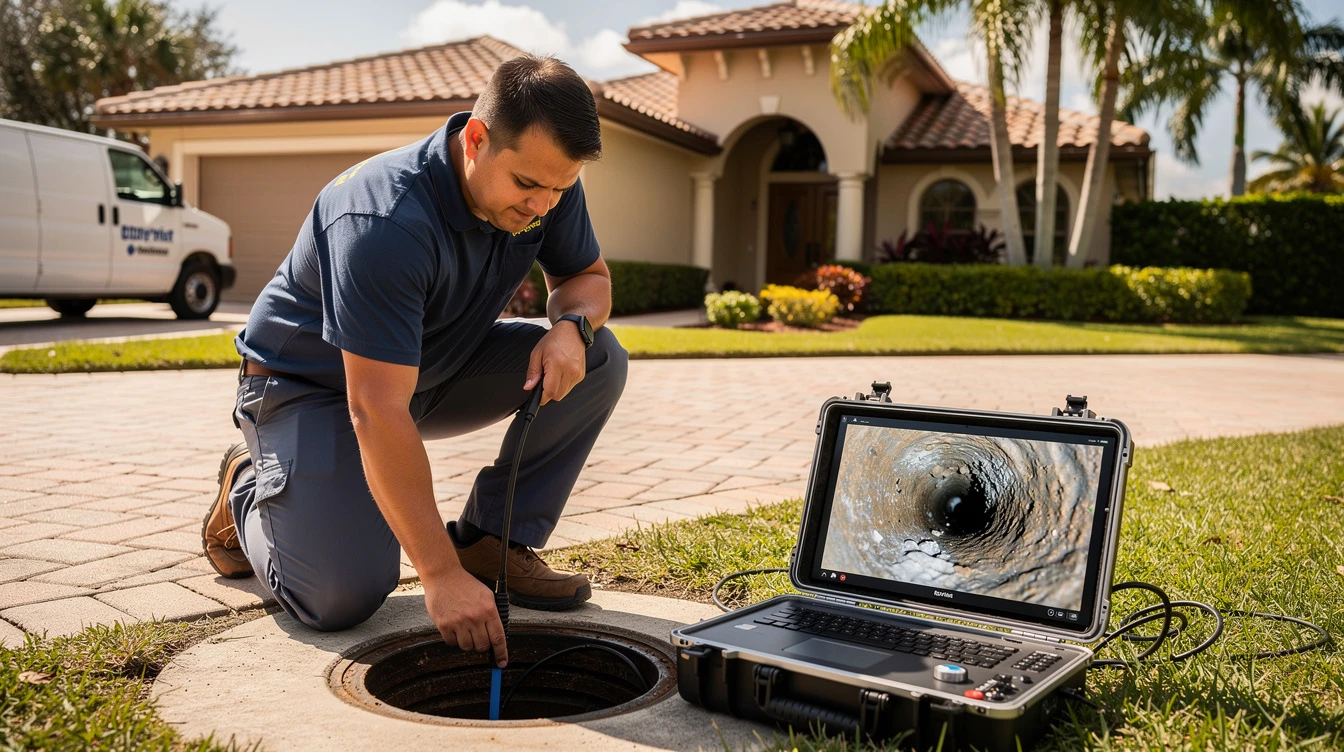
Hydro jetting in Boca Raton, built to stop the repeat backup.
A cable machine bores a hole through the center of a clog and calls it done. Grease, root hair and mineral scale simply cling to the walls and rebuild within weeks. Our truck-mounted hydro jetter scours the full inside diameter of the pipe at pressures up to 4000 PSI, and every job opens and closes with a camera pass so you watch the pipe go from coated to bare before we leave.
Signs your drain needs jetting, not another cable pass
Plenty of clogs respond just fine to a standard cable run, and when that's the case, we'll tell you honestly and charge you accordingly. But some lines have a coating problem, not a blockage problem, and a snake simply cannot touch that coating. If any of the patterns below sound familiar, hydro jetting is the tool that actually solves it instead of postponing the next call.
A kitchen line that gurgles every few weeks
Cooking oil and fat don't stay liquid once they cool in the pipe. They set into a lining that thickens every time you run hot water down the drain. A cable can punch a channel through that lining, but the walls stay coated and the channel closes back up. Jetting is the only method that physically scrubs the fat off the pipe surface so it doesn't just reappear.
Fine root hair strangling a joint
Tree and shrub roots find their way into a hairline gap at a pipe joint and multiply into a dense mat, chasing the moisture inside the line. High-pressure water shears that mat back down to the pipe wall and washes the fragments out toward the main, buying real breathing room while we figure out whether the joint itself needs sealing.
A drain that empties slower every year
Hard water leaves mineral deposits, and older galvanized or cast iron pipe corrodes from the inside, both of which shrink the usable opening a little more each season. A cable does nothing to remove that scale. The jetter's cutting nozzle strips it away and restores the pipe closer to its original bore, so drainage speed comes back rather than continuing to fade.
A restaurant or property that backs up like clockwork
If a commercial kitchen, laundromat or multi-unit building backs up on a predictable interval, that's a sign the grease trap outflow or a shared branch line needs a maintenance schedule, not one-off emergency calls. A recurring jetting plan keeps the line open year-round and heads off the shutdown that always happens at the worst possible moment.
Every fixture in the house draining slowly at once
Years of soap residue, lint and settled sediment build a shallow layer along the bottom of a main line, and once that layer is thick enough, everything upstream backs up together. A full-length jetting pass sweeps that accumulated sediment forward into the sewer connection and leaves the pipe genuinely clear from cleanout to connection, not just patched through the center.
You've cabled the same drain more than once this year
If a stubborn drain clog keeps returning within a month or two of a snake visit, that pattern itself is the diagnosis: the wall coating is the real problem, and cabling was only ever addressing the symptom. A jetting pass removes the source so you stop paying for the same visit twice a year.
Six steps, start to finish
Scope the pipe before touching anything
We run a sewer camera down the line to see exactly what we're dealing with: grease, roots, scale, or something structural like a crack or a bellied section. Skipping this step is how you end up jetting a pipe that couldn't take it. We don't skip it.
Stage the jetter and pick the right nozzle
The truck-mounted unit feeds a high-pressure hose in through the closest cleanout. We swap between a root-cutting head, a grease nozzle or a scale nozzle depending on exactly what the camera footage showed us seconds earlier.
Jet the entire length, not just the blockage
Water at up to 4000 PSI scours the pipe surface while rear-facing jets push the loosened material forward toward the sewer connection instead of leaving it to settle again a few feet downstream.
Scope it again to confirm the result
A second camera run shows the wall we just cleaned. You see the same bare pipe surface on the monitor that we do, which is the whole point of scoping twice instead of once.
Give you a straight answer on the footage
If the after-footage turns up a crack, an offset joint or a low spot holding water, we'll explain sewer line repair in plain terms and never push it on you. Every repair comes with a written parts-and-labor warranty.
Recommend a maintenance interval if it fits
Restaurants, laundromats and multi-unit buildings often benefit from a set jetting schedule so grease and sediment never rebuild to the point of a backup. It's a lot less disruptive than an emergency shutdown mid-shift.
A quick fix and a lasting fix are not the same job
Snaking still has its place. It's fast, it's gentle, and for a single fixture clogged with hair it's usually all a standard drain cleaning needs to accomplish. But once grease, roots or scale have coated the pipe walls, a cable only ever reopens the middle, and that channel narrows again within weeks.
Hydro jetting is the version of this service where the goal is an actually clean pipe, not a temporarily passable one. We scope the line with a camera first to make sure it can safely take the pressure, then run the jetter end to end so the call doesn't repeat itself next season.
Ask which one you need(561) 760-1677
Pricing is built on what the camera actually shows
We don't quote a hydro jetting job blind. The before footage tells us what's coating the line and how long the run is, and the after footage is what proves the job was done right. Here's what typically shapes the number you approve before the jetter ever fires up.
Pipe diameter
A two-inch branch line clears fast; a six-inch or larger main takes more volume and time.
What's coating the wall
Grease, root hair and hardened scale each call for a different nozzle and a different number of passes.
How we reach the line
An existing cleanout keeps the job simple; feeding the hose down a roof vent or through a fixture takes more setup.
Distance to the sewer tie-in
A short branch is quick work; a long run all the way to the street adds hose length and time.
Residential versus commercial
A single-family branch line is a different job than a grease-heavy commercial kitchen main.
Condition of the pipe on camera
Aging cast iron or clay pipe common in older South Florida properties changes the pressure and approach we use.
One dispatch line covering three South Florida counties
Palm Beach County
Broward County
Miami-Dade County
Other work we take on
Drain cleaning
The routine version: cable the line, then camera it to see whether jetting is warranted.
See drain cleaning →Clogged drain repair
One fixture stopped and overflowing, cleared the same day.
See clogged drain repair →Sewer line repair
For the crack, offset joint or low spot the after-footage sometimes reveals.
See sewer line repair →Trenchless sewer repair
Sealing the entry point roots keep using, without trenching the whole yard.
See trenchless repair →Cast iron replacement
When the scope shows iron too thin to jet safely.
See cast iron replacement →What the footage convinced them of
Our downstairs shower kept backing up every couple of months and the last plumber just cabled it and left. This crew scoped the line first, showed me the grease coating on the screen, jetted it, and then showed me a clean pipe. Nothing since.
Vanessa J. · Boca Raton
We manage a small strip mall and one tenant's grease line was a constant nuisance. They set us up on a quarterly jetting schedule instead of another emergency invoice. Two years in and we haven't had a single mid-day backup.
Wendell T. · Deerfield Beach
Appreciated that they scoped the pipe before blasting anything. Told me the scale had narrowed my old line significantly. After jetting, the tub drains almost instantly. Quoted a firm price before starting, no add-ons at the end.
Walter O. · Pompano Beach
Roots had gotten into our main from an old oak near the property line. They cameraed it, jetted the roots out, and were upfront that the joint would eventually need attention. No pressure sales, just honest information I could plan around.
Celia M. · West Palm Beach
Hydro jetting, explained
What actually makes jetting different from snaking?
A cable snake is a mechanical tool. It bores or hooks a path through whatever's blocking the middle of the pipe, and once that path is open, water flows again. What it doesn't touch is everything stuck to the walls around that path. Hydro jetting uses a rotating high-pressure nozzle to scour the entire inner surface of the pipe, which means the grease, root residue or scale that caused the clog gets physically removed rather than just tunneled through. That's the reason a jetted line typically stays open far longer than a snaked one.
Could high pressure damage my pipes?
It's a fair question, and it's exactly why every job starts with a camera pass instead of jumping straight to the jetter. We look at the pipe material, the joints and the overall condition before deciding on pressure and nozzle. Sound PVC, copper and healthy cast iron take jetting without any problem. If the scope shows a pipe that's already cracked, badly corroded or on the verge of collapse, we won't run the jetter through it; instead we'll show you the footage and talk through cast iron pipe replacement or a targeted repair.
Does jetting make sense for a small restaurant or café?
Almost always, yes. Food-service kitchens push a steady stream of fats, oils and food particles down the drain, and over time that residue hardens into a coating a snake can never remove for good. A backup mid-service costs you customers and potentially a health inspection headache. A scheduled jetting visit every few months keeps grease trap lines and branch drains genuinely open rather than temporarily passable, and it's a far smaller expense than an emergency call during a Friday dinner rush.
Will jetting get rid of tree roots in my sewer line for good?
A root-cutting jetter nozzle shears the intruding roots down to the pipe wall and flushes the debris out, which restores flow immediately. What jetting can't do is close the crack or gap the roots used to get in, so given enough time they'll likely find their way back through the same opening. After we jet, the camera lets us see exactly where the entry point is. If it's minor, a periodic jetting visit keeps it manageable; if the damage is significant, we'll walk you through trenchless sewer repair so the entry point actually gets sealed.
How long should I expect a jetting appointment to take?
A short residential branch line, camera passes included, is often wrapped up within an hour or two. A long grease-loaded commercial main, or a job with tricky access such as a rooftop vent, naturally takes longer. We'll give you a realistic time window once we've scoped the line and understood the full scope of the job, rather than guessing before we've even looked. Call us and we'll talk through your specific situation.
Stop paying for the same clog twice a year.
If a drain keeps coming back no matter how many times it's been cabled, hydro jetting removes the coating causing it, and the before-and-after camera footage proves the pipe is actually clean. Licensed and insured, backed by a written warranty on parts and labor across Palm Beach, Broward and Miami-Dade counties.
Call now · 24/7(561) 760-1677Licensed & insured · FL CFC1433655 · Boca Raton Emergency Plumbing SFL, 1220 Southwest 1st Way, Deerfield Beach, FL 33441 · Written warranty on parts and labor.