
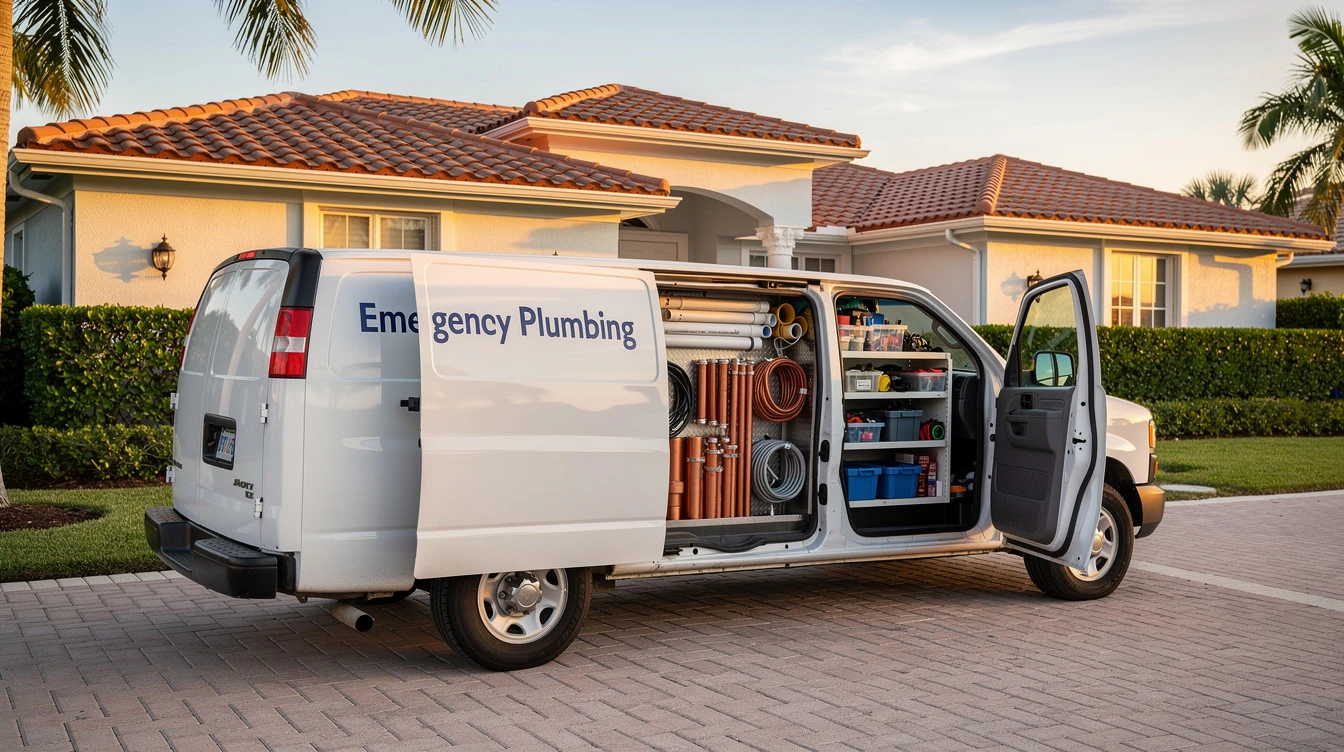
The Boca Raton Homeowner's Plumbing Survival Guide
A cracked supply line at midnight, a drain that won't clear, a water heater that finally quits: this is the reference we hand our own neighbors in Palm Beach County. It's built around the reality of coastal homes here, high humidity, concrete slabs, and drain lines that have been underground since the neighborhood was first platted.
First move: find the shutoff before you need it
A leak stops growing the moment the water is off. That means the most valuable plumbing skill in your house isn't a repair, it's knowing where the main valve sits and how it turns. On Boca Raton's slab-built homes, the shutoff is typically bolted to an exterior wall near where the supply line enters, often close to a hose bib or the garage. A quarter to half turn clockwise will stop most fixtures cold.
Municipal customers also have a meter box at the curb, a small lid set into the yard near the sidewalk. A basic meter key from any hardware store lets you close that valve too. Under sinks and behind toilets you'll find angle stops for shutting off a single fixture without killing water to the whole house. Find all three today, while nothing is wrong.
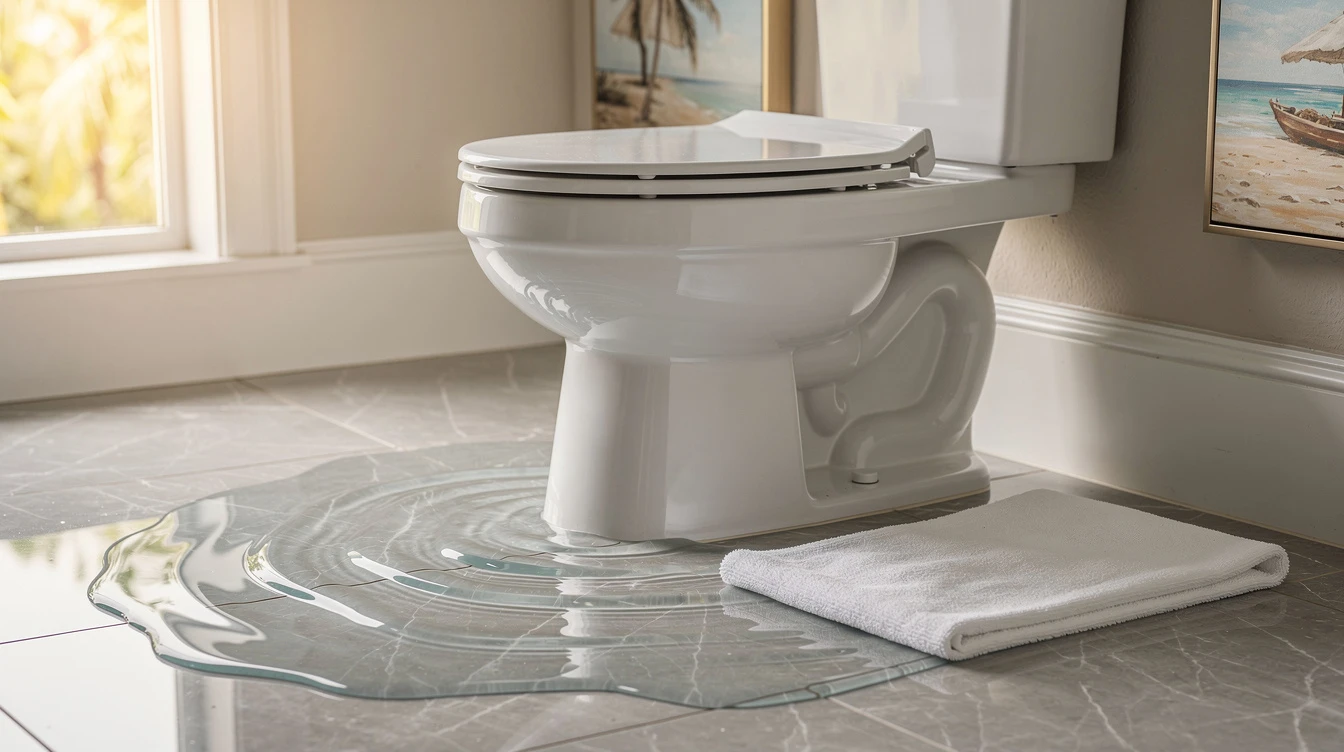
Try it this weekend
Walk the house and physically operate every shutoff you can find. A valve that won't turn, or spins loosely without resistance, needs attention now rather than during a flood. Book a routine emergency plumbing check if any of them feel wrong.
Five situations that mean stop and call now
Most plumbing issues can wait a day. These five can't. If any of them are happening in your home right now, shut off the water, get everyone clear, and reach us at (561) 760-1677. We answer day and night.
A supply line has split open
A ruptured supply line can send hundreds of gallons across a floor in minutes. Cut the main, crack a low faucet to bleed off pressure, and pull anything you value off the wet floor. Copper and CPVC both give way at fittings and pinhole spots first, and the older the plumbing, the more likely it fails without warning. It's exactly why we recommend scheduled leak detection. A weeping joint found on a scan is a repair estimate; the same joint found at 2 a.m. is a disaster.
Wastewater is rising, not draining
Dark water surfacing in a shower pan, low toilet, or floor drain, especially right after you flush or run a load of laundry, points to a blocked or failing sewer line. This is contaminated water, not a spill to mop up casually. Stop using every drain in the house until it's diagnosed. Older laterals in this area are prone to root intrusion and sagging sections; sometimes it's a straightforward clog, and sometimes the line itself needs trenchless sewer repair. Keep kids and pets away from the affected area regardless.
Every tap in the house has gone dry
Losing water entirely is sometimes a utility interruption, worth a quick check with a neighbor, but if it's isolated to your address, look at your main valve, the pressure regulator, or a hidden line dumping water somewhere out of sight. A meter dial that keeps spinning while every fixture is closed is proof water is escaping into the ground or slab. That combination usually means an undetected slab leak that needs to be located before it does more damage.
A gas water heater is leaking
This is two hazards at once: water spreading across the garage or utility closet, and a possible gas issue behind it. If there's any rotten-egg smell, leave the house immediately and call the gas company from outside, don't flip a switch on your way out. For a water-only leak, close the cold inlet valve on top of the tank and set the gas control to pilot or off. A tank pooling water at its base has usually failed for good, and a prompt water heater replacement is safer than patching a rusted shell.
Something's wrong under the floor
Slab construction hides the plumbing that runs beneath your tile, and a slab leak rarely announces itself loudly. Watch for a warm patch on the floor, the sound of water when every fixture is shut, musty odors with no obvious source, or a water bill that climbs without explanation. Left unaddressed, it can weaken the foundation and invite mold. Targeted leak detection finds the exact spot without opening the entire floor, a small repair instead of a full demolition.
While the truck is on its way
Once you've made the call, the time before we arrive is yours to protect the house. Work through this list, in order, without rushing:
Double-check the main valve is fully closed and bleed pressure at a low faucet.
Switch off power at the breaker for any zone where water is pooling near outlets.
Get furniture, rugs, and electronics up off the wet floor before they soak through.
Take a few photos of the damage before you start cleaning, for your insurance file.
Soak up what you safely can with towels, but stay away from standing water near live outlets.
Open the gate, clear the driveway, and secure pets so the technician can get straight to the source.
Skip the drain chemicals. A caustic product poured into a stopped line often just sits on top of standing water and can burn skin the moment the blockage breaks free. For a line that won't clear on its own, professional drain cleaning or hydro jetting does the job without that risk. Keep your phone nearby, we can often walk you through stabilizing the scene by phone at (561) 760-1677.
The four systems most likely to fail you
Understanding what you're working with makes you a better defender of your own home. In our climate, four systems generate most of the service calls, and each one ages in a fairly predictable pattern. Knowing the early warning signs is how you get ahead of a costly repair instead of reacting to it.
Ask us what yours has(561) 760-1677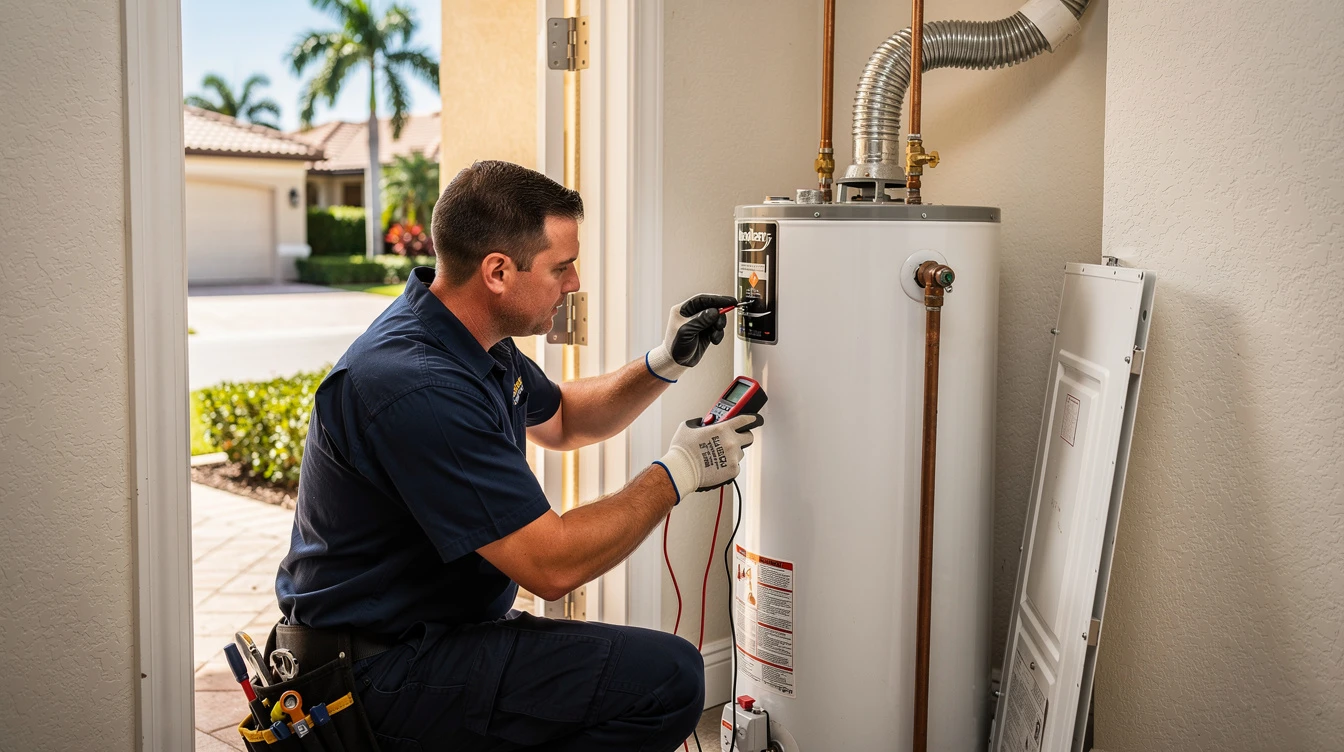
Drain and sewer lines
Drains only work as fast as gravity and a clear pipe allow. Grease, hair, mineral buildup, and outdoor tree roots all narrow that passage until water starts backing up. Slow drains in more than one fixture at once usually mean the main line is affected, not just a local clog. Repeat backups often trace to root intrusion or a sagging section, which is where hydro jetting or a camera inspection earns its cost. If the same drain clog keeps returning every few weeks, the pipe is the problem, not the drain.
Water heaters
Storage tank heaters here collect sediment fast, which insulates the burner, wastes energy, and slowly rusts the tank from the inside. Rumbling or popping noises, discolored hot water, and a longer wait for heat are all early flags. Most tanks last somewhere around 8 to 12 years, and pushing one well beyond that is how a garage floods overnight. Compare a repair against a replacement honestly: money spent on a corroded tank rarely buys much more time.
Cast iron pipes
Plenty of homes in this area still carry their original cast iron drain lines. Decades of use scale and crack the interior until the pipe is effectively rotting from within. Sewer odors, backups that return no matter what you try, and stains bleeding up through the slab are the tells. At that stage, patch repairs only buy a little time; a planned cast iron pipe replacement resets the whole system and stops the cycle for good.
Leaks you can't see
Not every leak announces itself with a puddle. The quiet ones run inside walls or beneath the slab for months, feeding mold and weakening the structure while your bill climbs. Watch for a meter that keeps moving when every fixture is off, warm spots on tile, or a persistent musty smell with no visible source. Acoustic and thermal leak detection catches these early, before they become the kind of repair that shuts down a whole room.
The short version
Know your shutoffs, take these five warning signs seriously, and treat small symptoms as an early opportunity rather than a nuisance to ignore. We're on call around the clock across Palm Beach County. Save (561) 760-1677, and keep browsing the guides below for the details.
Four focused guides
Four focused guides on the problems Boca Raton homeowners bring up most, what causes them, what they cost, and what to do next.
Toilet leaking quietly?
How to catch a running toilet before it wastes hundreds of gallons a month.
Guide 01 →Signs of a hidden leak
The bills, sounds, and stains that mean water is escaping somewhere out of view.
Guide 02 →What a new water heater costs
Repair or replace, tank or tankless, and the factors that actually move the price.
Guide 03 →When cast iron pipes fail
Why older drain lines break down over time, and when it's finally time to replace them.
Guide 04 →A leak doesn't keep business hours. Neither do we.
Read the guide once, then save the number. When something lets go at two in the morning you reach a person, not a menu, and a technician starts moving toward you.
Boca Raton Emergency Plumbing SFL · 1220 Southwest 1st Way, Deerfield Beach, FL 33441 · CFC1433655 · Water actively flooding? Skip the form and call.